Lafayette Anticipation associate curator Anna Colin talks to artist Tyler Coburn about Ergonomic Futures, a speculative project engaged with art, design, science, anthropology and writing. In this interview, Coburn discusses the research, production process and network of collaborators of a multilayered project ultimately concerned with the futures of humankind. Anna Colin: When one comes across your museum seats Ergonomic Futures (2016—) in contemporary art exhibitions—and soon in natural history, fine art, and anthropology museums—they look… [read more »]
The Concept of Non-Photography
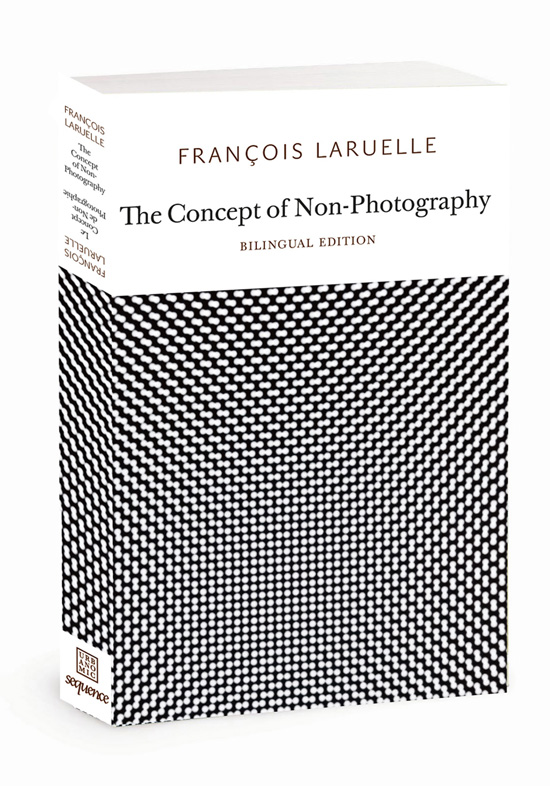
It’s dangerous to premise a definition, let alone a new theoretical approach, by outlining what it is not. And yet author François Laruelle could hardly have done otherwise with this new addition, published this year by Urbanomic/Sequence Press, to his work on non-philosophy- a term he coined. The “non-photography” of this eponymous study is set against myriad conventions, notably the idea of photography as somehow initiary, a jewel of Occidental prophesy fulfilled, mapping the world most perfectly according to how it actually appears. Laruelle, described by fellow philosopher Ray Brassier as “the most important unknown philosopher working in Europe today,” sees the photography he wants to oppose as embroiled in philosophy’s project of empirically articulating the world as both analysis and double. This splitting he says, which purports to allow the thinker (or photograph taker) to be objective, does not exist.
For the purposes of DIS and her photographer readership, The Concept of Non-Photography serves to affirm what we already assume, that the photograph creates an image anterior to both copy and abstraction. As Laruelle states, a photograph is a fiction: “wholly real but in its own mode”- the fictional realm. Interestingly, he aligns it not with philosophy but with scientific procedure, as this latter “eliminates from itself the philosophical correlation between fact and principle.” Or: a photograph is unique unto itself, an unlimited opening into the world occasioned by lights and shadows in time, but is in no way constrained by either the experiential universe or the theoretical and art historical preconditions set up for it. Or: for every budding photographer needled by art school teachers (“-But what does that mean in terms of Sherry Levine? ”) Laruelle gets you.
An important concept for Laruelle’s theory is the fractal. As assuredly as he dismisses the superficial simulacrity of the photo-effect, he asserts the fractal algorithm as a perfect example of how photographic self-similarity might function. A photo is infinite, having just one surface which extends forever, in the sense that it’s impossible to catch or qualify all the information in the sheen of emulsion on its surface. But like a fractal, any part of this one photograph contains the possibilities of All Photography in-its-entirety.
Laruelle has less to say on something like, say, a low res digital thumbnail, asserting its pixels like some undeveloped or primordial being under a microscope. In fact, he deliberately locks out all such distinctions as between digital and film-based photography from his conversation, as per his a priori dismissal of technical definitions from non-photography concerns. Conversely, what does non-photography mean for photo shoots like this one with their heightened attention to pre-production and post-production editing? Is the technical apparatus here still a minor player?
One senses Laruelle has a space for both this lowly pixeled jpeg, and its high production cousin, as steps in the arduous Heidegerrian task of revealing the world. But as a series of abstractions, the only method we have ever had at our disposal. Laruelle’s photographic apparatus “negotiates the re-entry of the World in the abstract photographic stance…And this synthesis- where the claim of the World over abstract vision-force is at once satisfied and postponed, where its resistance is admitted and displaced” [Author’s note: See the films of Jack Goldstein] “is perhaps nothing other than art.”
François Laruelle’s new book The Concept of Non-Photography is available as a bilingual (English/French) edition by Sequence Press in the US and Urbanomic in the UK.
Cat Kron is a contributor to Art in America and other publications.