Global .Wav

Global .Wav is a weekly presentation by Fatima Al Qadiri of attention-worthy music videos from around the world.

Ukraine, 2011?

This video is an undated remix of Ukranian pop star, Evgenia Vlasova’s aptly-named, “Wind of Hope” track from 2002. A pastiche of the original video and some amazing Windows ’97 kaleidoscopic beach templates (don’t quote me, I’m no screensaver connoisseur), the imagery is meant to elicit the most appropriate kind of “hope” — the default kitsch variety. The unmistakable thread lining a lot of Ukrainian pop music is that many artists are classically trained, which when translated into pop, manifests itself as hilariously un-innovative. This cross-blend of classical education and pop production is quite prominent in China and former Soviet countries. Alas, the results are excessively cheesy in a virtuosic kind of way, Evgenia can clearly hit some really high notes, but who cares? The bizarre chorus even contains a hint of early 90s Deep Forest style vocals (the kind spoken by a small tribe) transmuted into early 2000s scat. Actually, the entire song is early 90s era folk club sounding, especially at the 2:20 mark breakdown. And that fact is the most compelling feature of this song, in addition to Evgenia’s superbly awkward shoulder dance. Nothing like starting the year with a low res beach thumbnail-heavy, former Soviet bloc, post-opera, retro euro club track!

Angola, 2008

Ok, this is a kuduro video. There are a shitload of blog entries and articles about this genre hailing from Angola and the Angolan diaspora. Read up. I’m only discussing the video here, which is “Mama Kudi” by DJ Nays and Costuleta. The video begins with a BMW SUV pulling up on a dirt road, then all hell breaks loose. We see the requisite dancing girls, but more importantly, Costuleta—the one-legged co-producer of this track—is dancing with and without his crutches in a way that two-legged men could only dream of doing. In a variety of locations and outfits (this video is a collage of several others), Costuleta owns his disabled prowess, even adding a one-legged dancing boy (in basketball attire, no less) to make it all the more palatable. From his rippling and ripped, stone-washed jeans, we see a man possessed by life and the inescapably sick rhythm of kuduro. There’s a hilarious scene where he pretends to use his other shoe as a phone, while sliding up the floor. He repeats this gesture in a few other videos, making it his “thing.”

I can’t even begin to delve into his catalogue of outfits; they’re all fake, third world sporty genius—my favorite kind of sportswear. The video ends with Costuleta riding a bicycle and quickly cuts to him rollerblading through a mall!

Speechless? Join the club.

Iraq, 2011

I really wish I could just permanently blog about Iraqi music, it’s always on point. In this video, Hassan Hadi sings Aroosa, meaning “Bride.” The bride in question is at her dead husband’s grave, looking a little Matrix with her entourage. Hassan is coyly asking for a kiss with the permission of her dead man. Back up: Iraqis are an extremely melancholic people, and no amount of death references can faze them. They sing about death and love all the time in more ingenious ways than you could possibly imagine. My question is why is this bride captured in such an unflattering facial expression? She looks like she smelled Saddam’s zombie fart. And Hassan, his eyebrows, haircut, open fake polo shirt and soul patch are Levantine thug styling. Walk anywhere in the streets of Syria, Lebanon, Iraq or Jordan and you will encounter hordes of Hassans. It’s the look for men aged 20 to 40. Not to mention the location–I’m positive it’s Sweden (The Iraqi population is one of the largest ethnic minority groups currently residing in the country). The chorus travels on the refrain, “Oh bride, she’s wearing black. Oh bride, give me a kiss.” Um she’s a widow, dude. The song is sick and as with most Iraqi pop, the drums are like machine gun fire–very aptly heard at this romantic cemetery scene.

Dominican Republic, 2010

Omega “El Fuerte” is a singer with a musical double life. He has a repertoire of grandpa-style mambo, but also makes a kind of “narco merengue” or Merengue Electronico (the latter is also the name of a song of his), as exemplified in this video. The song is Tu Si Quieres (You Want It), and I’m sure he’s singing some gangsta lyrics cause the video is about someone, mainly him, getting shot and taken to hospital in slow motion. The video is barely interesting, and is posted strictly for audio purposes. The few notables are Omega’s Gucci baker boy hat–a hat that is a close rival to the fedora in the Vile Headgear Olympics–paired with Ed Hardy tee and leather jacket–against the obligatory BMW showroom shots so very dear to the hearts of thugs worldwide.

Merengueros (singers of Merengue, a Dominican genre) may seem comical to outsiders, with their visible lipgloss and wrap-around sunglasses acting all macho. Their posters are all over DIS’s official home, Hooper Street (AKA Hooper Place), so this is personal. We see their faces on a daily basis and know their names, Agaukate, Raulin Rodriguez, Tito Rojas, and so on. But Omega is different, grandpa mambo aside, his voice is unmistakable, deep and cold. And this genre is an obvious, however nascent progression. It’s nastier and harsher than regular merengue, which I personally have a hard time with as a result of the excess use of brass and piano combos. But Omega’s voice has one funny glitch, he occasionally tries to sing falsetto (it happens briefly for a few seconds in the middle of this song) and is endearingly bad. But overall, Omega has a few gems to his name, and this is one of them.
You just have to look hard and embrace the lipgloss.

Jamaica, 2009

Listening to Jamaican female MCs nowadays is like being pounded with a steel handbag. The violence of their vocals is real, and like most Jamaicans, they don’t give a fuck. This video is a dream duet between two such MCs, Spice and Pamputtae called Slim vs. Fluffy. And although the song is surprsingly about weight, slim vs. fat (fluffy)–a subject denigrating to women, this video inadvertently chills the heated issue with a pride-heavy sparring match.

The video battle between Slim and Fluffy girls–I’ll confess I’m partial to Fluffy–presents animated fantasy magazine covers, workout competitions, Broadway-style lights, matching glittery desses and boxing matches dedicated to “can’t do” combat zones. Pamputtae declares, “Me fat, but you can’t wine you waist like me.” Spice retorts, “Me slim, so a me have up di betta winery!” I pray for a Style Wines–instead of Wars–video where these statements appear as competition categories. The stylistic elements of the video, however varied, are completely overshadowed by the volcanic energy of the MCs, which is what really shines. Even though the random Chinese type and slogans on the Slim Girls Magazine cover is pretty amazing, Fluffy Girls mag with it’s “Fluffy Fashion” section wins my personal editorial prize. Pamputtae rules, ending the video when her iron booty culminates in the literal downfall of a Slim Boy. Where can I get a subscription?

Kurdistan, 2011

A Serb coined the term “Turbo Folk” in the late ’80s to describe a revved-up folk music via pop and dance engine fuel. And although Turbo Folk is inherently Serbian, I believe the term can be used to describe many a globally updated folk genre. Keeping this in mind, we approach the video for the song “Gal Gal Nazdaran” by Mehdi Alizadeh with a fast and furious zeal.

The song is an example of Kurdish folk music blended lovingly with a local interpretation of techno. Imagine the dreamy betrothal of a rural sheep herder to his cyber-goth, neon-dreadlocked wench. Ah! Such a heavenly match can yield only the most sublimely spliced offspring.

Before we delve into the video: for those who know little of Kurdish culture, contemporary use of the term “Kurdistan” refers to parts of eastern Turkey, northern Iraq, northwestern Iran, and northern Syria inhabited mainly by Kurds. And so, the Kurds are essentially a nationless people living literally on the edge… of four countries.

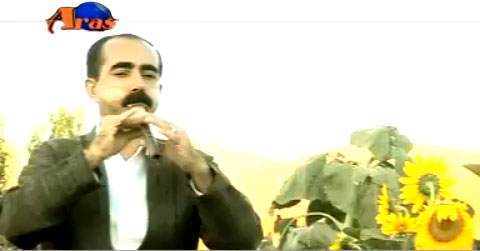
The intro of the video, especially the first 30-odd seconds, is surreal to the point of hallucinatory. Amidst a somewhat dark, techno-like track and much camera quake FX, we view a row of male dancers in a field, arms linked in a dabke-style line dance, wearing traditional brown jumpsuits. Our singer, Mehdi Alizadeh, suddenly appears, and the song transitions from techno to full-blown turbo folk. And much of the video revolves around the algorithm of capturing the dancers hopping to and fro dizzyingly intercut with our singer’s exceptional eyebrowèd countenance.

The universe of Kurdish line dancing videos is large; this otherworldly genre is just one tiny bubble in it. But as far as I’m concerned, Rural and Rave have never looked better.

Estonia, 2007?

As I searched for this week’s installment, I decided to go for a more random country, one that didn’t strike me as a primary magnet for world music lovers.

And that’s when I came across this confounding video for Raske loobuda, a song by the convivial Estonian duo, Pixie Twins. Confounding because it’s intensely comedic, while being entirely devoid of the later intention or any sense of self-awareness.
Basically, if a Hallmark card could be turned into an earnest music video, this is it. The art direction is an unabashed catalogue of near-shockingly generic poses and gestures. The mid 90′s Ann Taylor Loft styling, sedate fake-fur collars and choppy hair set against autumnal forest and northern beach are bewildering, because they so virulently embody the height of banality.

The song itself, which sounds like a cover of something I’d rather not be familiar with,might as well be white noise. The video inhabits a strange location, where blithe spirits toss autumn leaves at each other–one visited by bad Hollywood rom coms, advertising agencies, postcard makers, high street clothing catalogs from the past five decades, etc. This magnum opus of mawkishness reads like a spoof. But it goes far beyond that… Raske loobuda is a perky Video 101 presentation for a set of insipid, commercial stereotypes. And therein lies our corny beauty.

Pixie Twins take the scattering of pink rose petals into a picture-perfect river, in contempo-casual attire, very seriously.
And so should you.

Tanzania, 2007

Soggy Doggy (AKA Chief Rumanyka) has to be one of the best MC names out there. The fact that he’s rapping over what clearly sounds like Grime in Tanzania is totally badass.

The intro for this video features Soggy dangling a silver cross chain, behind him a beach full of people wearing white clothes, swaying to a Grimey beat. We then see Soggy, a man of small stature, practically drowning (in a good way) in triple XL basketball gear, walking down the street with his bros, clapping with Josephine–the angelic vocalist on the chorus. Cut to a disheveled man welcoming the viewer to a sign that reads, “Hot Pot Family Utajiju Communications Centre.” I’m gonna go ahead and assume, seeing his other videos, that Hot Pot Family is the name of Soggy’s crew, another ingenius title.The rest of the video contains much of the same, interspersed with small comic moments like the latter scene–reminiscent of some homemade British Grime videos that “take the mickey” out of one subject or another. And although the rapping on this song is not of a high calibre, the beat is unquestionably sick.

All I know is that Bongo Records, the Tanzanian label that’s signed Soggy and several other local acts–like the rapper Flexx, featured on an earlier Global .WAV entry–is on the right tip. Not to mention the fact that Josephine and her girls in white and navy Sean John attire are killing me softly.

Bulgaria, 2011

Where do I begin? If you haven’t already heard of Azis, Bulgaria’s uber pop tranny extravaganza, then let me clue you in. Aside from being named one of Bulgaria’s top ten celebrities, he possesses a large body of unreservedly homo-erotic, singularly-styled music videos.

The video for the song Nqma Nakude (“No Way”) is just one other-worldly work in a buffet of heavenly gems dripping from Azis’s perfectly trimmed, blonde beard. The scenario in this song, as in other videos, positively gags the viewer from start to finish. We find a naked man approaching the screen, cutting back and forth to Azis in several unbelievable looks (it’s the only word that fits). The man sits on a chair and spreads his legs, his genitals pixelated, as our heroine writhes longingly with hands. Cut to another scenario where three business men are being filmed by Azis (think crotch shots), as he takes on the reverse role of voyeur. And those hot pink mom glasses? His looks defy all expectations. Did you ever dream that a D&G-looking bustier paired with dangling, plastic star earrings and leather biker gloves would complement neatly cropped, bleach blonde facial hair and raccoon eyes? Or that a crown of metal thorns would eagerly await it’s menage a trois with a boat neck sailor top and oversized, full-length black skirt? That last look is really trying to tread Pierre et Giles territory, but otherwise I’m completely baffled and bedazzled. I just have one thing to say to all the upcoming tranny goddesses, listen and learn.

Tanzania, 2008?

The video for the song “Ni Soo” by Tanzanian heartthrob, Pasha, is brimming with saturated, earth tone sensuality.

But before we delve into the visual aspects of the video, let’s reflect on Swahili, the language of this song and the lingua franca of East Africa. Swahili has always held a mythical, slightly dreamy status in my mind, its name adapted from the Arabic word sawahil, meaning “coastal.” It’s widely spoken in the aforementioned and seemingly restive quarter of Africa, the one you rarely read about because they’re just chilling.

Or so I’d like to imagine. The song, which contains a strong R&B-style vocal, is undeniably catchy; I found myself humming its more-ish chorus all day. The setting of the video, which include the heavy presence of faux rosewood and russet brown furniture against cream-colored walls, delivers a particular kind of global interior aesthetic that is genuinely horrifying. One assumes this ubiquitous selection has been made with the intention to evoke warmth, but instead what I’m left with is the distinct chill of low-level anxiety. And yet, what absolves this uneasy interior from its Dettol-scented doom (Dettol, the world’s leading antiseptic brand) is the presence of our angelic singer, Pasha, whose unfiltered joyfulness is now etched in my brain. His fake Diesel tanktop, oversized Union Jack belt buckle, and unidentified denim are heaven-sent. The comments to this video merely reinforce my POV, that we are in the presence of an East African Eros whose mega-watt smile is powerful enough to end all suffering with one cursory beam.


Iran, 2006?

DJ Negar is a tween trance act from Iran, a trusted source of hyper-melancholic music.

In this first video, we find Negar decked out in a faux Formula-1 Racing outfit, complete with red baseball cap, in a TV studio recording. Her weepy facial expressions and praying/pleading hand gestures amidst a glistening sheen background visual is bewildering and begs me to ask, how did they reach this styling conclusion?

The name of the song is Age Mano Dustam Dari, which translates roughly as “If You Like/Love Me.” If only this was a Facebook-style song title, but it happens to be well known folk song. If you’re familiar with the Iranian penchant for sadness, you’ll know that her gestures are pretty liking/loving. As the song progresses, the studio backdrop reveals an ornamental green-screen shaded door (green-screen green incidentally is the holiest color in Islam). How befitting and post post modern. I immediately notice a split-second pattern: everything is red, white and green. The station logo, the backdrop of red and green walls mixed with Negar’s outfit, creates the colors of the Iranian flag. The rest of the video is pretty much the same. But that’s not important. The fact is this Islamic, girl tween, trance-y, Formula 1 lookbook is an astounding string of tags (Formula 1 clearly winning said tag race).

In Jam-e-Jahani, Negar does a duet with her trusty sidekick, Armin. Both wearing backwards red caps, Negar’s head solemnly hangs over her white, long sleeve tee while cheering sounds flare in the background. A background video of an Iranian flag-heavy soccer match plays and Armin begins to sing a downer, auto-tune vocal, flailing his arm in a gesture of aptly-stoned, heroic defiance. His red, black-striped, polo shirt with matching red arm band makes me question the significance of the color red in Iranian culture. I’m sure it’s major, but haven’t figured it out just yet.

After the awesome downer intro, a boisterous chorus of soccer-match-winning exuberance erupts onscreen. With the arms-up-in-the-air chorus concluded, our beloved tomboy idol of Iran, Negar, starts to sing and bop her head to the predictable beat. More of the same follows, ending the song in a corny clapping outro and heads hanging low, macho drama style.

After watching both videos, one can say that Negar’s nationalistic color scheme conditions her music to be some kind of patriotic trance. On the other hand, and ultra-nationalism aside, her obsession with athletic looks is on point and could easily appeal to tomboys worldwide. Overall, DJ Negar has the potential to be the global trance tween queen. If only that category was transformed into a reality TV show competition…

Afghanistan, 2007?

This incredible song, whose title remains mysterious, by the duo of Feroz & Naznin, allows the viewer to look into a demonized country’s entertainment. Afghani music remains largely unexplored by outsiders, and to a certain extent, is seen as existing in a medieval vacuum of classicist, folkloric genres. This video, and many others, challenge that cliched notion. The use of auto-tune for vocals, which although rampant across the globe, is refreshing in this unusual instance. Afghanistan lies between two ancient giants of musical influence—Iran to the west and India to the south— both influences are clearly audible in this song. The use of programmed, keyboard beats is remarkably fresh to the jaded ear, reflecting the enigmatic blend of Iranian and Indian rhythms.

But let’s not overlook the curtains, the fake plants, the color palette of maroon and sea foam green. The fact that everything is lip-synched, badly, and that the male singer is as stiff as a board—his clapping gesture is so minute, I wonder if it makes a sound! The dancing girls, their formation and serious moves, their long, whipped hair. This video is a treasure trove of gestures, moves, looks and interior design. A window into the real Afghanistan, beyond the constant media flow of burkas and Taliban.